Loneliness at Christmas: more common than it seems
· 5 min read
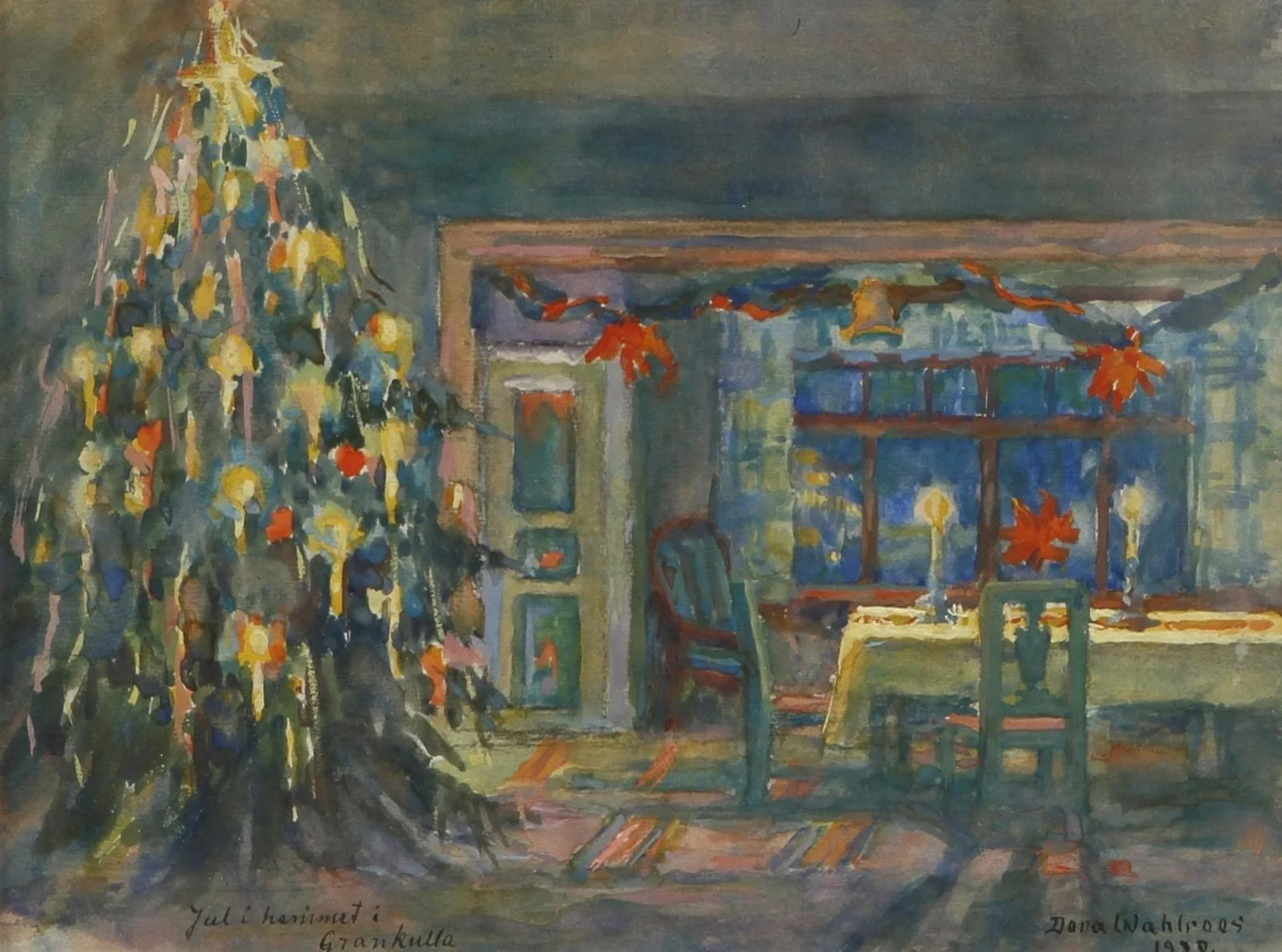
Dora Wahlroos, Joulukuusi (Christmas Tree), 1930. Wikimedia Commons, public domain.
O Natal costuma ser associado a união, família e reencontros. Mas, para muitas pessoas, esta época torna mais visíveis a solidão, a saudade e uma sensação de afastamento emocional. Mesmo rodeados de outras pessoas, podemos sentir que não estamos verdadeiramente ligados.
Num inquérito representativo realizado nos Estados Unidos, 31% dos adultos disseram ter sentido solidão durante alguma época festiva nos cinco anos anteriores. O dado não significa que todas estas pessoas se sintam mais sós em cada Natal, mas mostra que esta experiência está longe de ser rara.[1]
A solidão no Natal não é um fracasso pessoal, nem um sinal de que estamos a viver a época da forma errada. É uma experiência humana que merece compreensão e cuidado.
Quando estamos com pessoas, mas sem ligação
A solidão não depende apenas de estar fisicamente sozinho. A Organização Mundial da Saúde define-a como o sentimento doloroso que surge quando existe uma diferença entre as relações que temos e aquelas de que precisamos ou gostaríamos de ter. O isolamento social, por sua vez, refere-se à falta objetiva de contactos e relações.[2]
Podemos, por isso, estar numa sala cheia e sentir falta de ligação emocional, incompreensão ou um vazio difícil de explicar. Também podemos passar algum tempo sozinhos sem sofrimento: quando é escolhida, a solitude pode ser um espaço de descanso e reflexão. O que pesa não é apenas o número de pessoas à nossa volta, mas a qualidade e o significado das relações.[3]
A sensação de solidão pode tornar-se mais presente quando:
existe pouca afinidade ou segurança nos convívios;
há tensões silenciosas nos convívios;
estamos emocionalmente esgotados;
sentimos que "não encaixamos" no espírito festivo.
Quando parece que todos vivem um Natal "perfeito", torna-se mais difícil reconhecer que outras pessoas podem estar a sentir algo semelhante.
A saudade que o Natal desperta
Esta época do ano também reacende memórias e vínculos importantes. Para quem perdeu alguém, passou por um divórcio ou vive longe de pessoas e lugares significativos, o Natal pode tornar mais visível aquilo — e aqueles — que já não estão. É comum surgirem tristeza, nostalgia, melancolia ou a sensação de uma "cadeira vazia".[4]
A saudade não é o mesmo que solidão. Pode nascer da ausência de pessoas próximas, de intimidade, de lugares familiares ou de um tempo passado. Muitas pessoas descrevem-na como um misto de tristeza e carinho: pode doer e, ao mesmo tempo, preservar uma sensação de ligação. Isto não significa fraqueza nem constitui, por si só, um problema psicológico — é uma expressão natural do vínculo afetivo.[7]
Porque é que o Natal pode tornar a solidão mais presente?
Não existe um efeito igual para toda a gente. Ainda assim, há características desta época que podem acentuar ausências, necessidades de ligação ou memórias dolorosas:[3][4]
1. Pressão para sermos felizes
O Natal é frequentemente apresentado como uma época obrigatoriamente alegre. Quando isso não acontece, instala-se a sensação de "sou o único".
2. Comparação social
Redes sociais e publicidade reforçam imagens perfeitas que raramente correspondem à realidade. As redes não causam automaticamente solidão, mas um uso passivo e centrado na comparação pode agravar a sensação de distância.
3. Memória emocional
Datas festivas reavivam memórias, especialmente de pessoas significativas que já não estão presentes.
4. Ritmos diferentes
A pausa na rotina deixa mais espaço para refletir — e nem sempre isso é fácil.
5. Expectativas familiares
Nem todas as famílias são unidas ou oferecem segurança emocional. Para algumas pessoas, os convívios podem ser exigentes e limitar ou recusar um encontro difícil pode ser uma forma legítima de cuidado, não um fracasso.[8]
O que pode ajudar quando a solidão aperta?
A solidão natalícia é real e válida. Não existe uma solução única, mas algumas estratégias podem abrir espaço para maior conforto ou ligação. A investigação sobre intervenções para a solidão encontra efeitos geralmente pequenos a moderados e mostra que aumentar contactos não é suficiente quando falta qualidade emocional.[5]
1. Validar o que sente
Reconhecer o que sente, sem se censurar ou comparar, pode evitar que acrescente culpa à própria solidão.
2. Proteger as rotinas básicas
Pequenos gestos podem ajudar a atravessar dias emocionalmente exigentes:
fazer uma caminhada;
ouvir música tranquila;
ler algo de que goste;
tomar um banho quente;
preparar uma refeição simples.
Estes gestos podem proporcionar algum conforto e ajudar a cuidar de si num dia difícil. Não substituem, por si só, as relações de que sente falta.
3. Procurar ligações significativas
Um telefonema, uma mensagem ou um café podem ser pontos de partida. Mais do que acumular contactos, importa procurar alguém com quem seja possível falar com alguma abertura e segurança. Pode ser um familiar, um amigo ou outra pessoa que ocupe um lugar importante na sua vida; a pertença não depende de um único modelo de família.[9]
4. Participar em algo com propósito
Atividades solidárias ou pequenos gestos de ajuda podem criar oportunidades de contacto e sentido. Devem, porém, ser uma escolha e não mais uma obrigação natalícia.
5. Criar novos rituais
Não é obrigatório manter tradições que já não fazem sentido. Viajar, passar o dia ao ar livre, ver filmes ou simplesmente descansar também podem ser formas válidas de celebrar.
6. Acolher a saudade
Para quem perdeu alguém, pequenos rituais simbólicos — acender uma vela, ver fotografias ou escrever uma carta — podem trazer conforto e preservar a ligação afetiva. Nem todos os rituais ajudam todas as pessoas; o importante é respeitar o que faz sentido naquele momento.[6]
Se conhece alguém que possa estar sozinho, um convite simples e sem pressão pode fazer diferença. Estar disponível para escutar costuma ser mais útil do que tentar convencer a pessoa a "animar-se".[3]
Quando procurar ajuda?
Pode ser importante falar com um psicólogo quando a tristeza ou a solidão se prolongam, se tornam difíceis de suportar ou começam a afetar o sono, o apetite, as relações, o trabalho ou o interesse pelas atividades habituais. Não é necessário esperar por uma situação de crise para pedir ajuda.[3]
Em situação de crise, pode contactar o Serviço de Aconselhamento Psicológico da Linha SNS24 através do 808 24 24 24. Perante perigo imediato ou uma emergência, ligue 112.[4]
Christmas is usually associated with togetherness, family, and reunions. Yet for many people, this season makes loneliness, longing, and emotional distance more visible. Even when surrounded by others, we may feel that we are not truly connected.
In a representative US survey, 31% of adults said they had felt lonely during a holiday season at some point in the previous five years. This does not mean that all of them feel lonelier every Christmas, but it does show that the experience is far from rare.[1]
Loneliness at Christmas is not a personal failure, nor a sign that we are experiencing the season in the wrong way. It is a human experience that deserves understanding and care.
Being with people, but without connection
Loneliness does not depend solely on being physically alone. The World Health Organization defines it as the painful feeling that arises when there is a gap between the relationships we have and those we need or would like to have. Social isolation, by contrast, refers to an objective lack of contacts and relationships.[2]
We can therefore be in a full room and still feel emotionally distant, misunderstood, or unable to name a certain emptiness. We can also spend time alone without distress: when chosen, solitude may offer space for rest and reflection. What matters is not only how many people are around us, but the quality and meaning of our relationships.[3]
Loneliness may become more present when:
there is little affinity or safety in gatherings;
there are silent tensions in gatherings;
we are emotionally exhausted;
we feel that we do not "fit in" with the festive spirit.
When it seems that everyone is having a "perfect" Christmas, it becomes harder to recognise that other people may be feeling something similar.
The longing that Christmas awakens
This time of year also rekindles important memories and bonds. For those who have lost someone, gone through a divorce, or live far from significant people and familiar places, Christmas can make what — and who — is no longer there more visible. Sadness, nostalgia, melancholy, or the sense of an "empty chair" may emerge.[4]
Longing is not the same as loneliness. It may arise from the absence of close people, intimacy, familiar places, or a time in the past. Many people experience it as a mixture of sadness and affection: it can hurt while also preserving a sense of connection. This does not mean weakness, nor is it in itself a psychological problem — it is a natural expression of emotional attachment.[7]
Why can Christmas make loneliness more present?
Christmas does not affect everyone in the same way. Even so, some features of the season can accentuate absences, unmet needs for connection, or painful memories:[3][4]
1. Pressure to be happy
Christmas is often presented as an obligatorily joyful time. When that does not happen, a sense of "I am the only one" sets in.
2. Social comparison
Social media and advertising reinforce perfect images that rarely correspond to reality. Social media does not automatically cause loneliness, but passive use centred on comparison may deepen a sense of distance.
3. Emotional memory
Festive dates revive memories, especially of significant people who are no longer present.
4. Different rhythms
The pause in routine leaves more room for reflection — and that is not always easy.
5. Family expectations
Not all families are close or emotionally safe. For some people, gatherings can be demanding, and limiting or declining a difficult encounter may be a legitimate form of self-care rather than a failure.[8]
What can help when loneliness is overwhelming?
Christmas loneliness is real and valid. There is no single solution, but some strategies may create room for comfort or connection. Research on loneliness interventions generally finds small to moderate benefits and shows that increasing contact is not enough when emotional quality is missing.[5]
1. Validate what you feel
Acknowledging what you feel, without criticism or comparison, may prevent guilt from being added to loneliness itself.
2. Protect basic routines
Small gestures can help us move through emotionally demanding days:
go for a walk;
listen to calm music;
enjoy some reading;
take a warm bath;
prepare a simple meal.
These small gestures may offer some comfort and help you look after yourself on a difficult day. On their own, they do not replace the relationships you miss.
3. Seek meaningful connections
A phone call, a message, or a coffee can be a starting point. Rather than accumulating contacts, it is worth looking for someone with whom you can speak with some openness and safety. This may be a relative, a friend, or someone else who holds an important place in your life; belonging does not depend on a single model of family.[9]
4. Participate in something purposeful
Volunteering or small acts of help can create opportunities for contact and purpose. They should, however, be a choice rather than another Christmas obligation.
5. Create new rituals
It is not obligatory to maintain traditions that no longer make sense. Travelling, spending the day outdoors, watching films or simply resting can also be valid ways to celebrate.
6. Welcome the longing
For those who have lost someone, small symbolic rituals — lighting a candle, looking at photographs, or writing a letter — may bring comfort and preserve an emotional bond. Not every ritual helps everyone; what matters is respecting what feels meaningful at that moment.[6]
If you know someone who may be alone, a simple invitation without pressure can make a difference. Being available to listen is usually more helpful than trying to persuade the person to "cheer up".[3]
When to seek help?
It may be important to speak with a psychologist when sadness or loneliness persist, become difficult to bear, or begin to affect sleep, appetite, relationships, work, or interest in usual activities. You do not need to wait for a crisis before asking for help.[3]
In a crisis in Portugal, you can contact the Psychological Counselling Service of the SNS24 line on 808 24 24 24. If there is immediate danger or an emergency, call 112.[4]
Noël évoque généralement le partage, la famille et les retrouvailles. Pourtant, chez beaucoup de personnes, cette période ravive la solitude, le manque et un sentiment de distance affective. Même entourés, nous pouvons avoir l'impression de ne pas être véritablement en lien avec les autres.
Dans une enquête représentative menée aux États-Unis, 31 % des adultes ont déclaré avoir ressenti de la solitude pendant les fêtes au moins une fois au cours des cinq années précédentes. Cela ne signifie pas qu'ils se sentent tous plus seuls à chaque Noël, mais cette donnée montre que l'expérience est loin d'être rare.[1]
La solitude à Noël n'est ni un échec personnel ni le signe que nous vivons mal cette période. C'est une expérience humaine qui mérite d'être comprise et accueillie avec bienveillance.
Être entouré sans se sentir véritablement relié aux autres
La solitude ne dépend pas seulement du fait d'être physiquement seul. L'Organisation mondiale de la Santé la définit comme le sentiment douloureux qui apparaît lorsqu'il existe un décalage entre les relations que nous avons et celles dont nous avons besoin ou que nous souhaitons. L'isolement social désigne, quant à lui, un manque objectif de contacts et de relations.[2]
Nous pouvons donc nous trouver dans une pièce pleine de monde et nous sentir malgré tout isolés, incompris ou habités par un vide difficile à nommer. Nous pouvons aussi passer du temps seuls sans en souffrir : lorsqu'elle est choisie, la solitude peut offrir un espace de repos et de réflexion. Ce qui compte n'est pas seulement le nombre de personnes autour de nous, mais la qualité et le sens de nos relations.[3]
Le sentiment de solitude peut se faire davantage sentir lorsque :
nous nous sentons peu à notre place ou peu en sécurité lors des réunions ;
des tensions restent sous silence pendant les moments passés ensemble ;
on est émotionnellement épuisé ;
on a l'impression de ne pas correspondre à l'ambiance festive.
Quand tout le monde semble vivre un Noël « parfait », il devient plus difficile de se rappeler que d'autres personnes peuvent éprouver quelque chose de semblable.
Le manque que Noël ravive
Cette période de l'année ravive aussi d'importants souvenirs et liens. Lorsqu'on a perdu quelqu'un, que l'on a traversé un divorce ou que l'on vit loin de personnes et de lieux importants, Noël peut rendre plus sensible l'absence de ce qui — et de ceux qui — ne sont plus là. La tristesse, la nostalgie, la mélancolie ou le sentiment d'une « chaise vide » peuvent alors apparaître.[4]
Le manque n'est pas synonyme de solitude. Il peut naître de l'absence de personnes proches, d'intimité, de lieux familiers ou de moments révolus. Beaucoup le vivent comme un mélange de tristesse et de tendresse : il peut faire mal tout en préservant un sentiment de lien. Cette expérience n'est pas un signe de faiblesse et ne constitue pas, à elle seule, un problème psychologique — elle est une expression naturelle de l'attachement.[7]
Pourquoi la solitude peut-elle se faire davantage sentir à Noël ?
Noël n'a pas le même effet sur tout le monde. Certaines caractéristiques de cette période peuvent néanmoins rendre les absences plus sensibles, souligner les liens qui nous manquent ou raviver des souvenirs douloureux :[3][4]
1. La pression d'être heureux
Noël est souvent présenté comme une période nécessairement joyeuse. Lorsque nous ne nous sentons pas ainsi, l'impression d'être « le seul » peut s'installer.
2. La comparaison sociale
Les réseaux sociaux et la publicité mettent en avant des images idéalisées qui correspondent rarement à la réalité. Ils ne provoquent pas automatiquement la solitude, mais un usage passif centré sur la comparaison peut accentuer le sentiment de décalage.
3. La mémoire émotionnelle
Les dates festives raviven les souvenirs, notamment de personnes importantes qui ne sont plus présentes.
4. La rupture du rythme habituel
La pause dans nos habitudes laisse davantage de place aux pensées — et ce n'est pas toujours facile.
5. Les attentes familiales
Toutes les familles ne sont ni unies ni rassurantes sur le plan affectif. Pour certaines personnes, les réunions peuvent être éprouvantes. Limiter ou refuser une rencontre difficile peut alors être une manière légitime de se protéger, et non un échec.[8]
Qu'est-ce qui peut aider lorsque la solitude pèse ?
La solitude ressentie à Noël est réelle et légitime. Il n'existe pas de solution unique, mais certaines stratégies peuvent apporter un peu de réconfort ou favoriser le lien. Les recherches sur les interventions contre la solitude font généralement apparaître des effets faibles à modérés et montrent que multiplier les contacts ne suffit pas lorsque leur qualité affective fait défaut.[5]
1. Reconnaître ce que vous ressentez
Reconnaître ce que l'on ressent, sans se critiquer ni se comparer, peut éviter d'ajouter de la culpabilité à la solitude elle-même.
2. Protéger les routines essentielles
De petits gestes peuvent aider à traverser des journées émotionnellement exigeantes :
faire une promenade ;
écouter de la musique apaisante ;
lire quelque chose que l'on apprécie ;
prendre un bain chaud ;
préparer un repas simple.
Ces petits gestes peuvent apporter un peu de réconfort et aider à prendre soin de soi pendant une journée difficile. À eux seuls, ils ne remplacent pas les liens qui vous manquent.
3. Privilégier les liens qui comptent
Un appel, un message ou un café partagé peuvent constituer un point de départ. Plutôt que de multiplier les contacts, il peut être préférable de se tourner vers une personne avec laquelle il est possible de parler avec franchise et en confiance. Il peut s'agir d'un membre de la famille, d'un ami ou d'une autre personne importante pour vous ; le sentiment d'appartenance ne dépend pas d'un seul modèle familial.[9]
4. S'engager dans une activité qui a du sens
Les activités solidaires ou les petits gestes d'aide peuvent créer des occasions de rencontre et nourrir un sentiment d'utilité. Ils doivent toutefois rester un choix, et non devenir une obligation de plus liée à Noël.
5. Créer de nouveaux rituels
Il n'est pas nécessaire de maintenir des traditions qui n'ont plus de sens. Voyager, passer la journée en plein air, regarder des films ou simplement se reposer peuvent aussi être des manières tout aussi valables de marquer cette période.
6. Faire une place au manque
Pour les personnes qui ont perdu quelqu'un, de petits rituels symboliques — allumer une bougie, regarder des photographies ou écrire une lettre — peuvent apporter du réconfort et préserver le lien affectif. Tous les rituels ne conviennent pas à tout le monde ; l'important est de respecter ce qui a du sens à ce moment-là.[6]
Si vous pensez qu'une personne de votre entourage pourrait être seule, une invitation simple et sans pression peut faire la différence. Se rendre disponible pour l'écouter est généralement plus utile que de chercher à la convaincre de « se changer les idées ».[3]
Quand demander de l'aide ?
Il peut être important de parler à un psychologue lorsque la tristesse ou la solitude se prolongent, deviennent difficiles à supporter ou commencent à affecter le sommeil, l'appétit, les relations, le travail ou l'intérêt pour les activités habituelles. Il n'est pas nécessaire d'attendre une situation de crise pour demander de l'aide.[3]
En situation de crise au Portugal, vous pouvez contacter le service de conseil psychologique de la ligne SNS24 au 808 24 24 24. En cas de danger immédiat ou d'urgence, appelez le 112.[4]
Wilson Ferreira Santos is a psychologist registered with the Portuguese Psychologists Association, professional licence no. 25219.
These texts sit alongside a clinical practice centred on a careful and humane reading of psychological experience.
When loneliness grows stronger at a time meant for closeness
If Christmas or other dates make absence, longing or isolation more visible, it may be important to give that experience room without treating it as weakness.