Psychology and Christmas: why this season affects us so deeply
· 6 min read
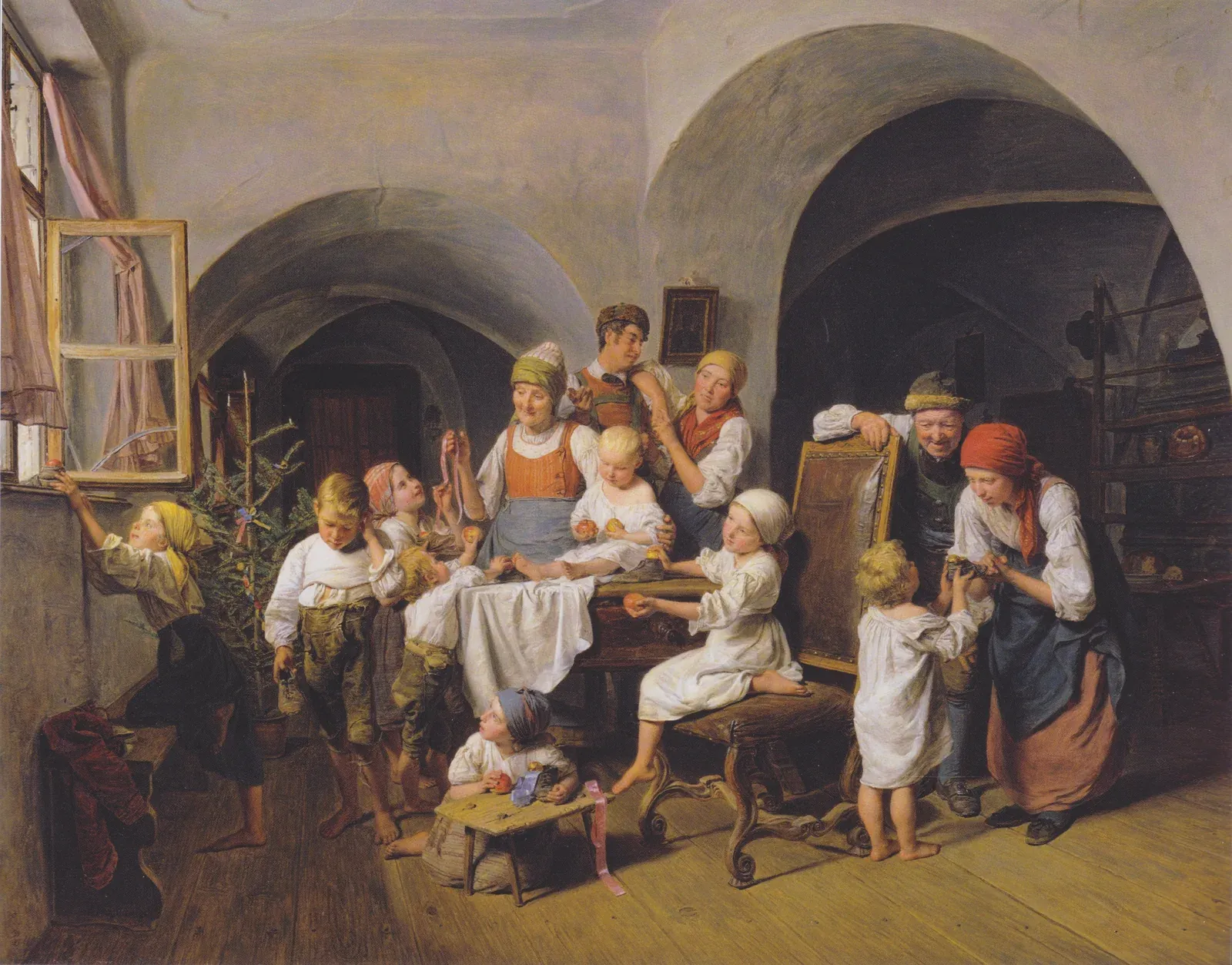
Ferdinand Georg Waldmüller, Christtagmorgen (Christmas Morning), 1844. Wikimedia Commons, public domain.
O Natal é frequentemente apresentado como uma época mágica, cheia de alegria, união familiar e momentos perfeitos. Mas, para muitos adultos, esta altura traz também stress, tristeza, cansaço e até um certo "desalinhamento" entre o que se espera sentir e o que realmente se sente. As duas experiências podem coexistir: é possível gostar do Natal e, ainda assim, sentir-se sobrecarregado por ele.
Num inquérito norte-americano de 2023, 89% dos adultos identificaram pelo menos uma fonte de stress nas festas e 41% disseram sentir mais stress nesta altura do que noutras épocas do ano. O dinheiro, a escolha de presentes e as saudades de familiares estavam entre as preocupações mais frequentes. Ao mesmo tempo, a maioria também associou a época a sentimentos positivos, o que ajuda a perceber o seu caráter agridoce.[1]
É por vezes usada a expressão informal holiday blues para descrever tristeza, solidão, ansiedade ou irritabilidade associadas a esta época. Não se trata de um diagnóstico nem significa que exista uma deterioração generalizada da saúde mental no Natal. Num estudo com dados de 11 países europeus, incluindo Portugal, a satisfação com a vida e o bem-estar emocional foram ligeiramente mais baixos no período natalício, mas o efeito foi pequeno e o desenho do estudo não permite concluir que o Natal tenha sido a causa.[2]
Quando o sofrimento é intenso, persiste para além das festas ou interfere com o sono, o trabalho, as relações ou os cuidados pessoais, não deve ser desvalorizado como algo meramente sazonal.
A obrigação de estar feliz
Desde cedo, somos expostos à imagem do "Natal perfeito": famílias felizes, mesas impecáveis, presentes, luzes e alegria constante. Quando a própria experiência não corresponde a esse cenário, pode surgir culpa, frustração ou a sensação de "não estar à altura". A investigação realizada em diferentes países associa a pressão social para estar feliz e não sentir emoções negativas a menor bem-estar, embora não permita afirmar que essa pressão seja a causa única desse mal-estar.[3]
Esta pressão pode nascer da combinação de vários fatores:
expectativas elevadas ou irreais;
comparação social, muito presente nas redes sociais;
pressão interna para "sentir o espírito natalício".
É importante lembrar: não há nada de errado em não sentir alegria permanente nesta época. Alegria, saudade, irritação, gratidão e cansaço não se anulam necessariamente. Cada pessoa vive o Natal à sua maneira — e nem todas as pessoas o celebram.
A comparação social: o Natal dos outros parece sempre melhor
As redes sociais podem acentuar a sensação de inadequação. Imagens de famílias sorridentes, casas decoradas e mesas perfeitas podem gerar frustração, sobretudo quando nos sentimos cansados ou vulneráveis. Este efeito não é inevitável nem igual para toda a gente, mas tende a ser mais marcado quando usamos o que vemos como medida para avaliar a nossa própria vida.
O que aparece online é apenas uma parte — muitas vezes a mais "arranjada" — da experiência dos outros. Recordar esse recorte não elimina a comparação, mas pode ajudar a pô-la em perspetiva.[4]
Porque é que o Natal mexe tanto connosco?
Existem vários fatores psicológicos que tornam esta altura emocionalmente intensa:
1. Memória emocional
O Natal ativa recordações. Algumas dão continuidade e conforto; outras estão ligadas a perdas, mudanças ou momentos difíceis. Por vezes, a mesma memória traz afeto e saudade.
2. Rotinas alteradas
Alimentação, sono, deslocações e ritmo diário podem mudar, influenciando o humor e a energia. A acumulação de tarefas e compromissos também pode dificultar um descanso verdadeiro.
3. Sobrecarga social e sensorial
Luzes, música constante, compras, filas e convívios sucessivos podem aumentar a irritabilidade e o cansaço. Para algumas pessoas, incluindo quem é mais sensível ao ruído, à luz ou às mudanças de rotina, esta exigência pode ser particularmente intensa.
4. Pressão cultural
A ideia de que "deve ser uma época feliz" pode criar um choque entre o que esperamos sentir e o que realmente sentimos. A pressão para gastar, oferecer e participar em tudo acrescenta ainda uma dimensão financeira e social.
O outro lado desta intensidade é o significado. Num pequeno estudo sobre o bem-estar no Natal, a proximidade familiar e a dimensão espiritual estiveram mais associadas ao bem-estar do que o consumo e a receção de presentes.[5] Outros estudos sugerem que os rituais partilhados — religiosos ou seculares — podem reforçar a proximidade e o envolvimento, desde que tenham sentido para quem participa.[6]
Isto não significa que estar com a família seja sempre protetor, nem que passar algum tempo sozinho seja necessariamente negativo. Uma reunião pode trazer ligação, mas também conflito ou solidão; a solitude escolhida pode ser reparadora. O que parece importar é a qualidade e o significado da experiência, não apenas o número de pessoas à mesa.
Também importa não transformar o dinheiro numa questão moral. Oferecer presentes pode ser uma forma genuína de afeto. O problema surge quando a obrigação, a competição ou o medo de desiludir empurram a pessoa para despesas que não pode suportar. Em dois estudos realizados no Reino Unido e na Noruega, a dificuldade financeira associou-se a maior propensão para recorrer a empréstimos, enquanto uma gestão mais antecipada do dinheiro se associou a menor propensão para o fazer.[7]
Estes fatores ajudam a perceber por que razão esta época pode ser difícil, mas não significam que o Natal tenha o mesmo efeito em toda a gente. Uma revisão de 25 estudos não encontrou um aumento da utilização de serviços de urgência psiquiátrica no Natal; os internamentos tenderam, aliás, a ser menos frequentes.[8] Isso não significa que o sofrimento individual esteja ausente: uma menor utilização dos serviços não mede tudo o que é vivido em casa, nem exclui adiamentos na procura de ajuda.
Aceitar o que sentimos — sem culpas
Dar espaço ao que sentimos, sem o julgar ou tentar expulsá-lo de imediato, pode evitar que acrescentemos uma segunda camada de luta à tristeza, ao cansaço ou à saudade. A investigação associa esta aceitação emocional a respostas menos intensas perante o stress e a melhor saúde psicológica ao longo do tempo.[9]
No Natal, isto significa permitir-se:
sentir tristeza ou saudade;
reconhecer o cansaço;
não forçar alegria;
respeitar as próprias necessidades.
Aceitar não significa gostar de tudo, resignar-se ou deixar de mudar o que está ao nosso alcance. Significa reconhecer a experiência real, em vez de gastar energia a fingir que ela corresponde à versão idealizada.
O que pode tornar a época mais suportável?
Não é necessário transformar o Natal num projeto de desempenho. Pode ser útil:
combinar um orçamento realista e reduzir a pressão associada aos presentes;
escolher os convívios em que faz sentido participar, em vez de tentar estar em todos, e reservar também algum tempo sem compromissos;
proteger tanto quanto possível o sono, as pausas e as rotinas básicas;
manter, adaptar ou abandonar tradições de acordo com a realidade atual, em vez de as cumprir apenas por obrigação;
preparar antecipadamente os momentos que possam ativar saudade, luto ou conflito e decidir com quem pode contar;
procurar apoio quando o sofrimento se torna difícil de gerir sozinho.
Pequenos limites não retiram significado à época. Muitas vezes, ajudam a preservar aquilo que nela é realmente importante.[10]
Em jeito de reflexão
O Natal é emocionalmente complexo: pode ser bonito e desafiador ao mesmo tempo. Não é, por si só, uma época psicologicamente nociva, nem garante proximidade e alegria. O seu impacto depende do equilíbrio entre significado, autonomia, ligação e descanso, por um lado, e obrigação, conflito, pressão financeira e sobrecarga, por outro.
Sentir esse impacto não é sinal de fraqueza. Compreender o que esta época desperta em nós permite fazer escolhas mais conscientes e construir uma celebração — ou uma não celebração — mais próxima daquilo de que realmente precisamos.
Este artigo centra-se nas expectativas, nas relações familiares e na pressão para viver um Natal feliz. A ausência de pessoas importantes e a falta de ligação são aprofundadas em Solidão e saudade no Natal.
Sezer, O., Norton, M. I., Gino, F., & Vohs, K. D. (2016). Family rituals improve the holidays. Journal of the Association for Consumer Research, 1(4), 509–526.
Christmas is often portrayed as a magical time, full of joy, family closeness, and perfect moments. Yet for many adults, the season also brings stress, sadness, tiredness, and a sense of mismatch between what they are expected to feel and what they actually feel. Both experiences can coexist: it is possible to enjoy Christmas and still feel overwhelmed by it.
In a 2023 US survey, 89% of adults identified at least one source of holiday stress, while 41% said they felt more stressed at this time of year than at other times. Money, choosing gifts, and missing family members were among the most common concerns. At the same time, most respondents also associated the season with positive feelings, which helps explain its bittersweet quality.[1]
The informal expression holiday blues is sometimes used to describe sadness, loneliness, anxiety, or irritability associated with this season. It is not a diagnosis, nor does it mean that mental health deteriorates across the board at Christmas. In a study using data from 11 European countries, including Portugal, life satisfaction and emotional wellbeing were slightly lower around Christmas, but the effect was small and the study design cannot establish that Christmas itself was the cause.[2]
When distress is intense, persists beyond the holidays, or interferes with sleep, work, relationships, or self-care, it should not be dismissed as merely seasonal.
The obligation to be happy
From an early age, we are exposed to the image of the "perfect Christmas": happy families, immaculate tables, gifts, lights, and constant joy. When our own experience does not match that picture, we may feel guilt, frustration, or a sense of falling short. Research across different countries has linked perceived social pressure to be happy and avoid negative emotions with poorer wellbeing, although it does not show that this pressure is the sole cause of such distress.[3]
This pressure can arise from a combination of factors:
high or unrealistic expectations;
social comparison, very prevalent on social media;
internal pressure to "feel the Christmas spirit".
It is important to remember: there is nothing wrong with not feeling constant joy during this season. Joy, longing, irritation, gratitude, and tiredness do not necessarily cancel one another out. Each person experiences Christmas in their own way — and not everyone celebrates it.
Social comparison: other people's Christmas always seems better
Social media can heighten feelings of inadequacy. Images of smiling families, decorated homes, and perfect tables may generate frustration, especially when we feel tired or vulnerable. This effect is neither inevitable nor the same for everyone, but it tends to be stronger when we use what we see as a measure of our own lives.
What appears online is only part of other people's experience — often the most polished part. Remembering that it is a selective picture does not eliminate comparison, but it can help put it into perspective.[4]
Why does Christmas affect us so deeply?
There are several psychological factors that make this time of year emotionally intense:
1. Emotional memory
Christmas activates memories. Some provide continuity and comfort; others are linked to loss, change, or difficult moments. Sometimes the same memory brings both affection and longing.
2. Disrupted routines
Food, sleep, travel, and daily rhythms may change, affecting mood and energy. The build-up of tasks and commitments can also make genuine rest difficult.
3. Social and sensory overload
Lights, constant music, shopping, queues, and successive gatherings can increase irritability and exhaustion. For some people, including those who are more sensitive to noise, light, or changes in routine, these demands can be particularly intense.
4. Cultural pressure
The idea that "this should be a happy time" can create a clash between what we expect to feel and what we actually feel. Pressure to spend, give, and take part in everything adds a financial and social dimension.
This intensity also has another side: meaning. In a small study of Christmas wellbeing, family closeness and spiritual experiences were more strongly associated with wellbeing than spending and receiving gifts.[5] Other studies suggest that shared rituals — whether religious or secular — can strengthen closeness and involvement, provided they are meaningful to those taking part.[6]
This does not mean that being with family is always protective, or that spending some time alone is necessarily negative. A gathering may bring connection, but it may also bring conflict or loneliness; chosen solitude can be restorative. What seems to matter is the quality and meaning of the experience, not simply the number of people around the table.
It is equally important not to turn money into a moral issue. Giving presents can be a genuine expression of affection. The problem arises when obligation, competition, or fear of disappointing others pushes someone towards spending they cannot afford. In two studies conducted in the United Kingdom and Norway, financial hardship was associated with a greater inclination to borrow, while more proactive money management was associated with a lower inclination to do so.[7]
These factors help explain why the season can be difficult, but they do not mean that Christmas affects everyone in the same way. A review of 25 studies found no increase in the use of psychiatric emergency services at Christmas; hospital admissions actually tended to be lower.[8] This does not mean that individual distress is absent: lower use of services cannot capture everything people experience at home, nor does it rule out delays in seeking help.
Accepting what we feel — without guilt
Making room for what we feel, without judging it or trying to drive it away immediately, can prevent us from adding a second layer of struggle to sadness, tiredness, or longing. Research links this emotional acceptance to less intense responses to stress and better psychological health over time.[9]
At Christmas, this means allowing yourself to:
feel sadness or longing;
acknowledge tiredness;
not force joy;
respect your own needs.
Acceptance does not mean liking everything, resigning yourself to it, or giving up on changing what you can. It means recognising the experience you are actually having, rather than spending energy pretending that it matches the idealised version.
What can make the season more manageable?
Christmas does not need to become a performance project. It may help to:
agree on a realistic budget and reduce the pressure associated with gifts;
choose which gatherings genuinely matter rather than trying to attend them all, and leave some time free of commitments;
protect sleep, breaks, and basic routines as far as possible;
keep, adapt, or let go of traditions according to your present circumstances, rather than following them solely out of obligation;
prepare in advance for moments that may stir grief, longing, or conflict, and decide whom you can turn to;
seek support when distress becomes difficult to manage alone.
Small boundaries do not take meaning away from the season. They often help preserve what truly matters about it.[10]
A moment for reflection
Christmas is emotionally complex: it can be beautiful and challenging at the same time. It is not inherently harmful to mental health, nor does it guarantee closeness and joy. Its impact depends on the balance between meaning, autonomy, connection, and rest on the one hand, and obligation, conflict, financial pressure, and overload on the other.
Feeling that impact is not a sign of weakness. Understanding what the season stirs in us can help us make more conscious choices and shape a celebration — or a choice not to celebrate — around what we actually need.
This article focuses on expectations, family relationships and the pressure to have a happy Christmas. Missing important people and feeling disconnected are explored further in Loneliness and longing at Christmas.
Sousa, M. (2024). Montras da (im)perfeição: Natal, imagem pessoal e comparação social [Displays of (im)perfection: Christmas, personal image, and social comparison]. In Ordem dos Psicólogos Portugueses, Artigos de opinião 2024.
Sezer, O., Norton, M. I., Gino, F., & Vohs, K. D. (2016). Family rituals improve the holidays. Journal of the Association for Consumer Research, 1(4), 509–526.
Ordem dos Psicólogos Portugueses. (n.d.). Natal & saúde psicológica [Christmas and psychological health].
Revised on 26 September 2026.
Noël est souvent présenté comme une période magique, pleine de joie, de proximité familiale et de moments parfaits. Pourtant, pour beaucoup d'adultes, cette période apporte aussi du stress, de la tristesse, de la fatigue et un certain décalage entre ce que l'on est censé ressentir et ce que l'on ressent réellement. Ces expériences peuvent coexister : il est possible d'aimer Noël tout en se sentant dépassé par cette période.
Dans une enquête américaine de 2023, 89 % des adultes ont identifié au moins une source de stress pendant les fêtes, tandis que 41 % ont déclaré ressentir davantage de stress à cette période qu'à d'autres moments de l'année. L'argent, le choix des cadeaux et l'absence de proches figuraient parmi les préoccupations les plus fréquentes. Dans le même temps, la majorité associait aussi cette période à des sentiments positifs, ce qui aide à comprendre son caractère doux-amer.[1]
L'expression informelle holiday blues, ou « blues des fêtes », est parfois employée pour décrire la tristesse, la solitude, l'anxiété ou l'irritabilité associées à cette période. Il ne s'agit pas d'un diagnostic, et cela ne signifie pas que la santé mentale se dégrade globalement à Noël. Dans une étude fondée sur les données de 11 pays européens, dont le Portugal, la satisfaction à l'égard de la vie et le bien-être émotionnel étaient légèrement plus faibles autour de Noël. L'effet était toutefois modeste et le dispositif de l'étude ne permet pas d'affirmer que Noël en était la cause.[2]
Lorsque la souffrance est intense, persiste après les fêtes ou perturbe le sommeil, le travail, les relations ou la capacité à prendre soin de soi, elle ne doit pas être minimisée comme un simple phénomène saisonnier.
L'obligation d'être heureux
Dès le plus jeune âge, nous sommes exposés à l'image du « Noël parfait » : familles heureuses, tables impeccables, cadeaux, lumières et joie constante. Lorsque notre propre expérience ne correspond pas à ce tableau, de la culpabilité, de la frustration ou le sentiment de ne pas être à la hauteur peuvent apparaître. Des recherches menées dans différents pays associent la pression sociale à devoir être heureux et à ne pas éprouver d'émotions négatives à un moindre bien-être, sans pour autant montrer que cette pression soit l'unique cause du mal-être.[3]
Cette pression peut naître de plusieurs facteurs combinés :
des attentes élevées ou irréalistes ;
la comparaison sociale, très présente sur les réseaux sociaux ;
la pression intérieure pour « ressentir l'esprit de Noël ».
Il est important de se rappeler : il n'y a rien d'anormal à ne pas ressentir une joie permanente en cette période. Joie, nostalgie, irritation, gratitude et fatigue ne s'annulent pas nécessairement. Chacun vit Noël à sa façon — et tout le monde ne le célèbre pas.
La comparaison sociale : le Noël des autres semble toujours plus réussi
Les réseaux sociaux peuvent accentuer le sentiment de ne pas être à la hauteur. Des images de familles souriantes, de maisons décorées et de tables parfaites peuvent susciter de la frustration, surtout lorsque nous nous sentons fatigués ou vulnérables. Cet effet n'est ni inévitable ni identique pour tout le monde, mais il tend à être plus marqué lorsque ce que nous voyons devient une mesure de notre propre vie.
Ce qui apparaît en ligne ne représente qu'une partie de l'expérience des autres — souvent la plus soignée. Se rappeler qu'il s'agit d'une image partielle ne supprime pas la comparaison, mais peut aider à la remettre en perspective.[4]
Pourquoi Noël nous touche-t-il autant ?
Plusieurs facteurs psychologiques rendent cette période émotionnellement intense :
1. Mémoire émotionnelle
Noël réactive des souvenirs. Certains apportent un sentiment de continuité et de réconfort ; d'autres sont liés à des pertes, des changements ou des moments difficiles. Un même souvenir peut parfois mêler affection et nostalgie.
2. Routines bouleversées
L'alimentation, le sommeil, les déplacements et le rythme quotidien peuvent changer, avec des effets sur l'humeur et l'énergie. L'accumulation de tâches et d'engagements peut également empêcher un véritable repos.
3. Surcharge sociale et sensorielle
Les lumières, la musique constante, les achats, les files d'attente et les rencontres successives peuvent accroître l'irritabilité et la fatigue. Pour certaines personnes, notamment celles qui sont plus sensibles au bruit, à la lumière ou aux changements de routine, ces sollicitations peuvent être particulièrement intenses.
4. Pression culturelle
L'idée que « cette période doit être joyeuse » peut créer un décalage entre ce que nous espérons ressentir et ce que nous ressentons réellement. La pression à dépenser, à offrir et à participer à tout ajoute une dimension financière et sociale.
L'autre versant de cette intensité est le sens que l'on donne à la période. Dans une petite étude sur le bien-être à Noël, la proximité familiale et les expériences spirituelles étaient davantage associées au bien-être que les dépenses et les cadeaux reçus.[5] D'autres études suggèrent que les rituels partagés — religieux ou laïques — peuvent renforcer la proximité et l'implication, à condition d'avoir du sens pour les personnes qui y participent.[6]
Cela ne signifie pas qu'être en famille soit toujours protecteur, ni que passer du temps seul soit nécessairement négatif. Une réunion peut apporter de la proximité, mais aussi du conflit ou de la solitude ; une solitude choisie peut être réparatrice. Ce qui semble compter, c'est la qualité et le sens de l'expérience, et non le seul nombre de personnes autour de la table.
Il importe également de ne pas faire de l'argent une question morale. Offrir des cadeaux peut être une véritable expression d'affection. Le problème apparaît lorsque l'obligation, la compétition ou la peur de décevoir poussent une personne à des dépenses qu'elle ne peut pas assumer. Dans deux études menées au Royaume-Uni et en Norvège, les difficultés financières étaient associées à une plus grande propension à emprunter, tandis qu'une gestion plus anticipée de l'argent était associée à une moindre propension à le faire.[7]
Ces facteurs aident à comprendre pourquoi cette période peut être difficile, mais ils ne signifient pas que Noël produise le même effet sur tout le monde. Une revue de 25 études n'a constaté aucune augmentation du recours aux urgences psychiatriques à Noël ; les hospitalisations avaient même tendance à être moins fréquentes.[8] Cela ne signifie pas que la souffrance individuelle soit absente : un moindre recours aux services ne rend pas compte de tout ce qui est vécu à la maison et n'exclut pas que certaines personnes retardent leur demande d'aide.
Accepter ce que nous ressentons — sans culpabilité
Faire une place à ce que nous ressentons, sans le juger ni chercher à le chasser immédiatement, peut éviter d'ajouter une seconde couche de lutte à la tristesse, à la fatigue ou au manque d'un proche. La recherche associe cette acceptation émotionnelle à des réactions moins intenses face au stress et à une meilleure santé psychologique au fil du temps.[9]
À Noël, cela signifie se permettre :
de ressentir de la tristesse ou de la nostalgie ;
de reconnaître la fatigue ;
de ne pas forcer la joie ;
de respecter ses propres besoins.
Accepter ne signifie pas tout apprécier, se résigner ou renoncer à changer ce qui peut l'être. Il s'agit de reconnaître l'expérience telle qu'elle est, plutôt que de dépenser son énergie à prétendre qu'elle correspond à une version idéalisée.
Qu'est-ce qui peut rendre cette période plus supportable ?
Noël ne doit pas devenir une épreuve de performance. Il peut être utile de :
convenir d'un budget réaliste et réduire la pression associée aux cadeaux ;
choisir les rencontres qui ont réellement du sens plutôt que d'essayer d'être partout, et préserver aussi du temps sans engagements ;
préserver autant que possible le sommeil, les pauses et les routines essentielles ;
conserver, adapter ou abandonner certaines traditions en fonction de la réalité actuelle, plutôt que de les suivre uniquement par obligation ;
anticiper les moments susceptibles de réveiller le deuil, le manque ou les conflits, et identifier les personnes sur lesquelles compter ;
chercher du soutien lorsque la souffrance devient difficile à gérer seul.
Poser quelques limites n'enlève rien au sens de cette période. Cela aide souvent à préserver ce qui compte vraiment.[10]
En guise de réflexion
Noël est émotionnellement complexe : il peut être beau et difficile à la fois. Il n'est pas en soi nocif pour la santé mentale, pas plus qu'il ne garantit la proximité et la joie. Son impact dépend de l'équilibre entre le sens, l'autonomie, les liens et le repos, d'une part, et l'obligation, les conflits, la pression financière et la surcharge, d'autre part.
Ressentir cet impact n'est pas un signe de faiblesse. Comprendre ce que cette période éveille en nous permet de faire des choix plus conscients et d'adapter notre manière de célébrer — ou de choisir de ne pas célébrer — à ce dont nous avons réellement besoin.
Cet article porte sur les attentes, les relations familiales et la pression de vivre un Noël heureux. L’absence de personnes importantes et le manque de liens sont abordés plus en détail dans Solitude et nostalgie à Noël.
Sousa, M. (2024). Montras da (im)perfeição: Natal, imagem pessoal e comparação social [Vitrines de l'(im)perfection : Noël, image personnelle et comparaison sociale]. Dans Ordem dos Psicólogos Portugueses, Artigos de opinião 2024.
Sezer, O., Norton, M. I., Gino, F., & Vohs, K. D. (2016). Family rituals improve the holidays. Journal of the Association for Consumer Research, 1(4), 509–526.