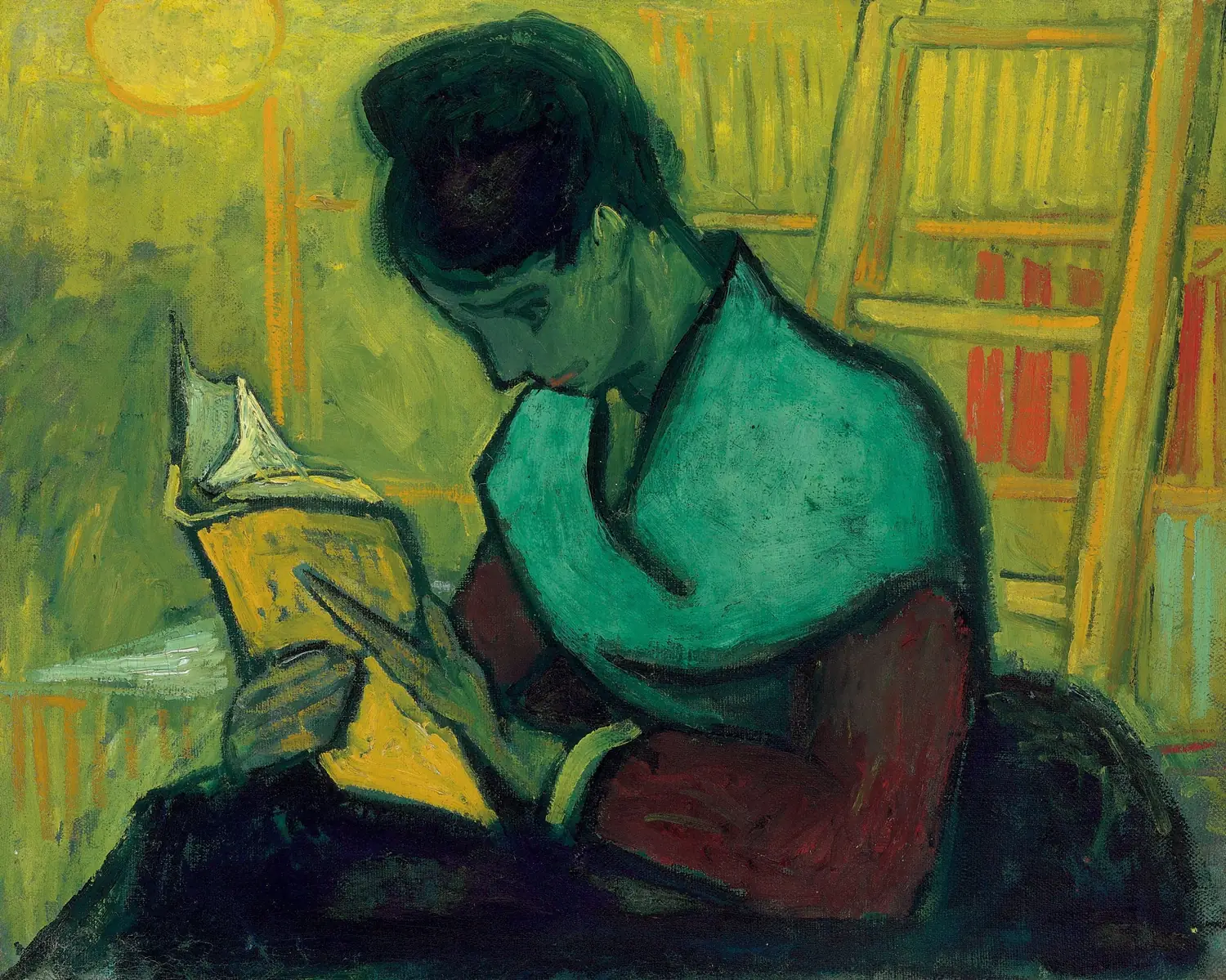
Image: Vincent van Gogh, Une liseuse de romans, 1888 / Wikimedia Commons, public domain.
Assistimos, hoje em dia, a um fluxo constante de notícias sobre o estado do mundo. Para onde quer que nos viremos, pode parecer que tudo está errado, e isso pode alimentar uma visão pessimista e um sentimento de ansiedade.
Sobrecarga de informação
Para além dos meios tradicionais, as redes sociais, os vídeos curtos e as notificações fazem com que as notícias nos cheguem mesmo quando não estamos à procura delas. O fluxo não tem um princípio nem um fim claros: uma atualização conduz à seguinte e a mesma imagem pode reaparecer em vários canais, por vezes sem contexto. Nem todos reagimos da mesma maneira. Em Portugal, 37% das pessoas inquiridas em 2026 disseram evitar as notícias algumas vezes ou frequentemente.[1] Este afastamento pode ser uma forma de regular a sobrecarga, embora também possa deixar algumas pessoas menos informadas sobre assuntos relevantes.
A cobertura noticiosa e as publicações nas redes sociais tendem ainda a dar visibilidade ao que é novo, conflitual ou dramático. Num grande estudo de campo que comparou títulos diferentes para a mesma notícia, cada palavra negativa adicional aumentou, em média, a probabilidade de clique; emoções negativas distintas não tiveram todas o mesmo efeito.[2] Isto mostra que a linguagem negativa pode captar atenção, mas não significa que todas as notícias sejam negativas nem que exista uma simples preferência universal por "más notícias".
Ansiedade mediática não é um diagnóstico
A expressão ansiedade mediática descreve aqui o stress, a preocupação ou o estado de alerta associados ao contacto com notícias e conteúdos mediáticos. Não corresponde a um diagnóstico clínico. Sentir medo ou tristeza perante uma guerra, uma catástrofe ou uma crise política pode ser uma resposta humana compreensível. A questão é perceber a intensidade, a duração e o impacto: o contacto com as notícias informa e ajuda a agir, ou mantém a pessoa num estado de ameaça sem acrescentar compreensão?
Num inquérito da American Psychological Association realizado nos Estados Unidos em 2017, 56% dos adultos disseram que acompanhar as notícias lhes causava stress.[3] Um estudo experimental mostrou também que ver um boletim composto por notícias negativas podia aumentar momentaneamente a ansiedade e a tristeza, assim como a tendência para imaginar o pior acerca de preocupações pessoais.[4] Este efeito imediato não significa, por si só, que ver notícias cause uma perturbação de ansiedade.
A presença dos meios de comunicação na vida quotidiana também não é uma preocupação nova. Nos anos 1920, Cora May White, de Minneapolis, pediu o divórcio alegando que o marido prestava mais atenção à rádio do que a ela.[5] A anedota é de outra época, mas lembra-nos que cada nova tecnologia pode ocupar espaço psicológico e relacional. A diferença atual está na disponibilidade contínua, na personalização e na facilidade com que imagens e alertas nos acompanham ao longo do dia.
Quando informar-se se transforma num ciclo
Consultar notícias várias vezes não é necessariamente um problema. O sinal mais útil é a função que esse comportamento cumpre. Algumas pessoas procuram uma informação concreta e param quando a encontram; outras regressam repetidamente para aliviar a incerteza, mas obtêm apenas um alívio breve e sentem necessidade de voltar a verificar. Quando a absorção pelas notícias interfere com o sono, a concentração, o trabalho ou os relacionamentos, fala-se por vezes em consumo problemático de notícias. A investigação encontra uma associação com pior bem-estar psicológico e físico, mas este conceito é recente e não constitui um diagnóstico reconhecido.[6]
O estado de espírito também influencia aquilo que procuramos. Estudos sobre navegação na internet sugerem um ciclo de duas direções: um humor mais negativo favorece a escolha de conteúdos mais negativos e essa exposição pode, por sua vez, piorar o humor.[7] Num estudo diário realizado durante a pandemia, numa amostra específica de pessoas de minorias sexuais e de género, a exposição a mais notícias sobre a COVID-19 associou-se a pior afeto e houve indícios de relações bidirecionais entre exposição e sofrimento.[8] Estes resultados não permitem concluir que qualquer leitura de notícias faça mal; mostram antes que conteúdo, repetição, contexto e vulnerabilidade pessoal importam.
Nem toda a exposição tem o mesmo peso
Ler uma explicação contextualizada não é psicologicamente igual a ver repetidamente imagens gráficas, vídeos em reprodução automática ou transmissões em direto de um acontecimento traumático. A investigação sobre atentados, guerras e violência coletiva associa a exposição extensa a imagens gráficas a mais sintomas de stress, sobretudo quando o contacto é repetido.[9] Isto não quer dizer que as pessoas devam ignorar acontecimentos graves, mas que podem informar-se sem se exporem continuamente às imagens mais perturbadoras.
Também importa a proximidade psicológica. Uma notícia pode tocar diretamente numa experiência passada, envolver familiares, ameaçar uma comunidade a que se pertence ou deixar a pessoa sem qualquer possibilidade de ação. Nesses momentos, limitar a exposição não é indiferença. Pode ser uma forma de conservar capacidade para pensar, cuidar de si e responder ao que realmente está ao seu alcance.
Gestão do stress
Informar-se continua a ser importante. O objetivo não é construir uma bolha sem más notícias, mas escolher uma relação mais deliberada com elas. Se o consumo de notícias está a interferir com o bem-estar ou com os relacionamentos, podem ser úteis algumas mudanças simples.
5 formas de lidar com a ansiedade mediática:
Definir momentos e fontes: escolher uma ou duas fontes credíveis e horários concretos para se informar, em vez de consultar continuamente vários canais. Desligar alertas que não sejam verdadeiramente necessários ajuda a devolver intenção ao gesto de abrir as notícias.
Perguntar o que procura: antes de voltar a atualizar a página, perceber se precisa de informação nova, de orientação para agir ou apenas de reduzir a incerteza. Quando já não existe nada de útil a acrescentar, continuar a verificar raramente traz a segurança procurada.
Limitar imagens repetidas: desativar a reprodução automática, evitar rever vídeos gráficos e preferir texto ou áudio quando as imagens o deixam particularmente perturbado. É possível compreender a gravidade de um acontecimento sem assistir repetidamente ao seu momento mais violento.
Procurar contexto e respostas: combinar a atualização imediata com análises mais lentas e com jornalismo que examine respostas possíveis, sem negar os problemas. A investigação sobre jornalismo construtivo encontra efeitos relativamente consistentes nas emoções, embora outros benefícios ainda sejam menos claros.[10]
Reconhecer quando precisa de apoio: retomar rotinas, conversas, descanso e atividades fora dos ecrãs. Se o impacto persistir, afetar o sono ou o funcionamento diário, ou se as notícias reativarem uma experiência traumática, o apoio de um profissional de saúde mental pode ser benéfico.
Estar informado e proteger a saúde mental não são objetivos incompatíveis. A informação é mais útil quando aumenta a compreensão ou permite escolher uma ação; torna-se menos útil quando apenas prolonga o estado de alarme.
Today, we are exposed to a constant stream of news about the state of the world. Wherever we turn, it can seem as if everything is going wrong, and that can feed a more pessimistic view of the world and a sense of anxiety.
Information overload
Beyond traditional news outlets, social media, short videos and notifications bring us news even when we are not looking for it. The flow has no clear beginning or end: one update leads to the next, and the same image may reappear across several channels, sometimes without context. We do not all respond in the same way. In Portugal, 37% of respondents in 2026 said they sometimes or often avoid the news.[1] Stepping away may be a way to regulate overload, although it can also leave some people less informed about matters that affect them.
News coverage and social media posts also tend to give prominence to what is new, conflictual or dramatic. In a large field study comparing different headlines for the same story, each additional negative word increased the likelihood of a click on average; different negative emotions did not all have the same effect.[2] This shows that negative language can capture attention, but it does not mean that all news is negative or that everyone has a simple, universal preference for "bad news".
Media anxiety is not a diagnosis
The expression media anxiety is used here to describe stress, worry or heightened alertness associated with news and media content. It is not a clinical diagnosis. Feeling fear or sadness in response to war, a disaster or a political crisis can be an understandable human reaction. The useful questions concern intensity, duration and impact: does following the news increase understanding and help you act, or does it keep you in a state of threat without adding clarity?
In a 2017 American Psychological Association survey conducted in the United States, 56% of adults said that following the news caused them stress.[3] An experiment also showed that watching a bulletin made up of negative news could briefly increase anxiety and sadness, as well as the tendency to imagine the worst about personal concerns.[4] This immediate effect does not, on its own, mean that watching the news causes an anxiety disorder.
Concerns about the place of media in everyday life are nothing new. In the 1920s, Cora May White of Minneapolis filed for divorce, saying that her husband paid more attention to the radio than to her.[5] The anecdote belongs to another era, but it reminds us that each new technology can occupy psychological and relational space. What is different today is continuous availability, personalisation and the ease with which images and alerts follow us throughout the day.
When staying informed becomes a cycle
Checking the news several times is not necessarily a problem. A more useful sign is the function the behaviour serves. Some people look for a specific fact and stop when they find it; others return repeatedly to ease uncertainty, but gain only brief relief and soon feel the need to check again. When absorption in the news interferes with sleep, concentration, work or relationships, researchers sometimes refer to problematic news consumption. Studies associate it with poorer psychological and physical well-being, but the concept is recent and is not a recognised diagnosis.[6]
Mood also influences what we look for. Research on web browsing suggests a two-way cycle: a more negative mood favours the selection of more negative material, and exposure to that material can in turn worsen mood.[7] In a daily study conducted during the pandemic in a specific sample of sexual and gender minority people, greater exposure to COVID-19 news was associated with poorer affect, with some evidence of bidirectional links between exposure and distress.[8] These findings do not show that any amount of news is harmful; they suggest that content, repetition, context and personal vulnerability matter.
Not all exposure carries the same weight
Reading a contextualised explanation is not psychologically equivalent to repeatedly watching graphic images, autoplaying videos or live coverage of a traumatic event. Research on terrorist attacks, war and collective violence links extensive exposure to graphic media images with more stress symptoms, particularly when exposure is repeated.[9] This does not mean people should ignore serious events, but they can remain informed without continually viewing the most disturbing images.
Psychological proximity matters too. A story may connect directly with a past experience, involve family members, threaten a community to which someone belongs or leave them with no meaningful way to act. At such times, limiting exposure is not indifference. It can be a way of preserving the ability to think, care for oneself and respond to what is actually within reach.
Managing stress
Staying informed still matters. The aim is not to build a bubble without bad news, but to choose a more deliberate relationship with it. If news consumption is interfering with well-being or relationships, a few simple changes may help.
5 ways to manage media anxiety:
Choose times and sources: select one or two credible sources and specific times to catch up instead of continually checking several channels. Turning off alerts that are not genuinely necessary helps make opening the news an intentional act again.
Ask what you are looking for: before refreshing once more, notice whether you need new information, guidance for action or simply relief from uncertainty. When there is nothing useful left to add, continued checking rarely provides the security being sought.
Limit repeated images: turn off autoplay, avoid replaying graphic videos and choose text or audio when images are particularly distressing. It is possible to understand the seriousness of an event without repeatedly watching its most violent moment.
Look for context and responses: combine immediate updates with slower analysis and reporting that examines possible responses without denying the problem. Research on constructive journalism finds relatively consistent effects on emotions, although evidence for other benefits is less clear.[10]
Recognise when you need support: return to routines, conversations, rest and activities away from screens. If the impact persists, affects sleep or daily functioning, or if the news reactivates a traumatic experience, support from a mental health professional may help.
Staying informed and protecting mental health are not incompatible aims. Information is most useful when it increases understanding or helps us choose an action; it becomes less useful when it merely prolongs a state of alarm.
Aujourd'hui, nous sommes exposés à un flux constant d'informations sur l'état du monde. Où que nous regardions, il peut sembler que tout va mal, ce qui peut nourrir une vision plus pessimiste du monde et un sentiment d'anxiété.
Surcharge d'information
Au-delà des médias traditionnels, les réseaux sociaux, les vidéos courtes et les notifications nous apportent l'actualité même lorsque nous ne la cherchons pas. Le flux n'a ni début ni fin clairement définis : une mise à jour mène à la suivante et une même image peut réapparaître sur plusieurs canaux, parfois sans contexte. Nous ne réagissons pas tous de la même façon. Au Portugal, 37 % des personnes interrogées en 2026 ont déclaré éviter parfois ou souvent l'actualité.[1] Prendre ses distances peut aider à réguler la surcharge, mais peut aussi laisser certaines personnes moins informées sur des sujets qui les concernent.
La couverture médiatique et les publications sur les réseaux sociaux tendent également à mettre en avant ce qui est nouveau, conflictuel ou dramatique. Dans une vaste étude de terrain comparant plusieurs titres pour une même information, chaque mot négatif supplémentaire augmentait en moyenne la probabilité de cliquer ; toutes les émotions négatives n'avaient cependant pas le même effet.[2] Cela montre que le langage négatif peut capter l'attention, mais pas que toute l'actualité est négative ni que chacun possède une préférence simple et universelle pour les « mauvaises nouvelles ».
L'anxiété médiatique n'est pas un diagnostic
L'expression anxiété médiatique désigne ici le stress, l'inquiétude ou l'état d'alerte associés à l'actualité et aux contenus médiatiques. Il ne s'agit pas d'un diagnostic clinique. Ressentir de la peur ou de la tristesse face à une guerre, une catastrophe ou une crise politique peut être une réaction humaine compréhensible. Les questions utiles portent sur l'intensité, la durée et les conséquences : suivre l'actualité permet-il de mieux comprendre et d'agir, ou cela maintient-il la personne dans un état de menace sans apporter davantage de clarté ?
Dans une enquête menée aux États-Unis en 2017 par l'American Psychological Association, 56 % des adultes ont déclaré que suivre l'actualité leur causait du stress.[3] Une étude expérimentale a également montré que regarder un journal télévisé composé de nouvelles négatives pouvait accroître momentanément l'anxiété et la tristesse, ainsi que la tendance à imaginer le pire à propos de préoccupations personnelles.[4] Cet effet immédiat ne signifie pas, à lui seul, que regarder les informations provoque un trouble anxieux.
La place des médias dans la vie quotidienne suscite des préoccupations depuis longtemps. Dans les années 1920, Cora May White, de Minneapolis, a demandé le divorce en affirmant que son mari accordait plus d'attention à la radio qu'à elle.[5] L'anecdote appartient à une autre époque, mais rappelle que chaque nouvelle technologie peut occuper un espace psychologique et relationnel. Ce qui diffère aujourd'hui, c'est la disponibilité continue, la personnalisation et la facilité avec laquelle les images et les alertes nous accompagnent toute la journée.
Quand s'informer devient un cycle
Consulter plusieurs fois l'actualité ne constitue pas nécessairement un problème. Un indice plus utile est la fonction que remplit ce comportement. Certaines personnes cherchent une information précise et s'arrêtent lorsqu'elles l'ont trouvée ; d'autres reviennent sans cesse pour atténuer l'incertitude, mais n'obtiennent qu'un bref soulagement et ressentent bientôt le besoin de vérifier à nouveau. Lorsque l'absorption dans l'actualité perturbe le sommeil, la concentration, le travail ou les relations, les chercheurs parlent parfois de consommation problématique de l'information. Les études l'associent à un moins bon bien-être psychologique et physique, mais cette notion est récente et ne constitue pas un diagnostic reconnu.[6]
L'humeur influence aussi ce que nous recherchons. Les travaux sur la navigation en ligne suggèrent un cycle à double sens : une humeur plus négative favorise le choix de contenus plus négatifs, et cette exposition peut à son tour assombrir l'humeur.[7] Dans une étude quotidienne menée pendant la pandémie auprès d'un échantillon spécifique de personnes appartenant à des minorités sexuelles et de genre, une plus forte exposition aux informations sur la COVID-19 était associée à un affect plus négatif, avec certains indices de relations bidirectionnelles entre exposition et détresse.[8] Ces résultats ne montrent pas que toute lecture de l'actualité est nocive ; ils suggèrent que le contenu, la répétition, le contexte et la vulnérabilité personnelle comptent.
Toutes les formes d'exposition n'ont pas le même poids
Lire une explication contextualisée n'est pas psychologiquement équivalent au fait de regarder à répétition des images explicites, des vidéos en lecture automatique ou la retransmission en direct d'un événement traumatique. Les recherches sur les attentats, les guerres et la violence collective associent une exposition importante à des images médiatiques explicites à davantage de symptômes de stress, notamment lorsque cette exposition se répète.[9] Cela ne signifie pas qu'il faille ignorer les événements graves, mais qu'il est possible de s'informer sans revoir continuellement les images les plus éprouvantes.
La proximité psychologique compte elle aussi. Une nouvelle peut faire directement écho à une expérience passée, concerner des proches, menacer une communauté à laquelle on appartient ou ne laisser aucune possibilité d'action. Dans ces moments, limiter son exposition n'est pas de l'indifférence. Cela peut permettre de préserver sa capacité à réfléchir, à prendre soin de soi et à répondre à ce qui est réellement à sa portée.
Gestion du stress
Rester informé demeure important. L'objectif n'est pas de construire une bulle sans mauvaises nouvelles, mais de choisir une relation plus délibérée avec celles-ci. Si la consommation d'informations interfère avec le bien-être ou les relations, quelques changements simples peuvent être utiles.
5 façons de gérer l'anxiété médiatique :
Choisir des moments et des sources : sélectionner une ou deux sources fiables et des horaires précis pour s'informer, au lieu de consulter continuellement plusieurs canaux. Désactiver les alertes qui ne sont pas réellement nécessaires permet de redonner une intention au geste d'ouvrir l'actualité.
Se demander ce que l'on cherche : avant d'actualiser une nouvelle fois la page, repérer si l'on a besoin d'une information nouvelle, d'une piste pour agir ou simplement de réduire l'incertitude. Lorsqu'il n'y a plus rien d'utile à apprendre, continuer à vérifier apporte rarement la sécurité recherchée.
Limiter la répétition des images : désactiver la lecture automatique, éviter de revoir des vidéos explicites et préférer le texte ou l'audio lorsque les images sont particulièrement éprouvantes. Il est possible de comprendre la gravité d'un événement sans regarder à répétition son moment le plus violent.
Chercher du contexte et des réponses : compléter les mises à jour immédiates par des analyses plus lentes et des articles qui examinent des réponses possibles sans nier les problèmes. Les recherches sur le journalisme constructif observent des effets relativement constants sur les émotions, tandis que les preuves d'autres bénéfices restent moins nettes.[10]
Reconnaître le besoin de soutien : revenir aux routines, aux conversations, au repos et aux activités hors écran. Si l'impact persiste, affecte le sommeil ou le fonctionnement quotidien, ou si l'actualité réactive une expérience traumatique, le soutien d'un professionnel de santé mentale peut être bénéfique.
Rester informé et protéger sa santé mentale ne sont pas des objectifs incompatibles. L'information est plus utile lorsqu'elle augmente la compréhension ou permet de choisir une action ; elle le devient moins lorsqu'elle ne fait que prolonger l'état d'alerte.
Wilson Ferreira Santos is a psychologist registered with the Portuguese Psychologists Association, professional licence no. 25219.
These texts sit alongside a clinical practice centred on a careful and humane reading of psychological experience.
When the news starts taking up too much space
If constant exposure to news leaves you on alert, exhausted or unable to switch off, it may help to talk through the place this anxiety has taken in daily life.