The time change: what it does to our body and how to adapt
· 4 min read
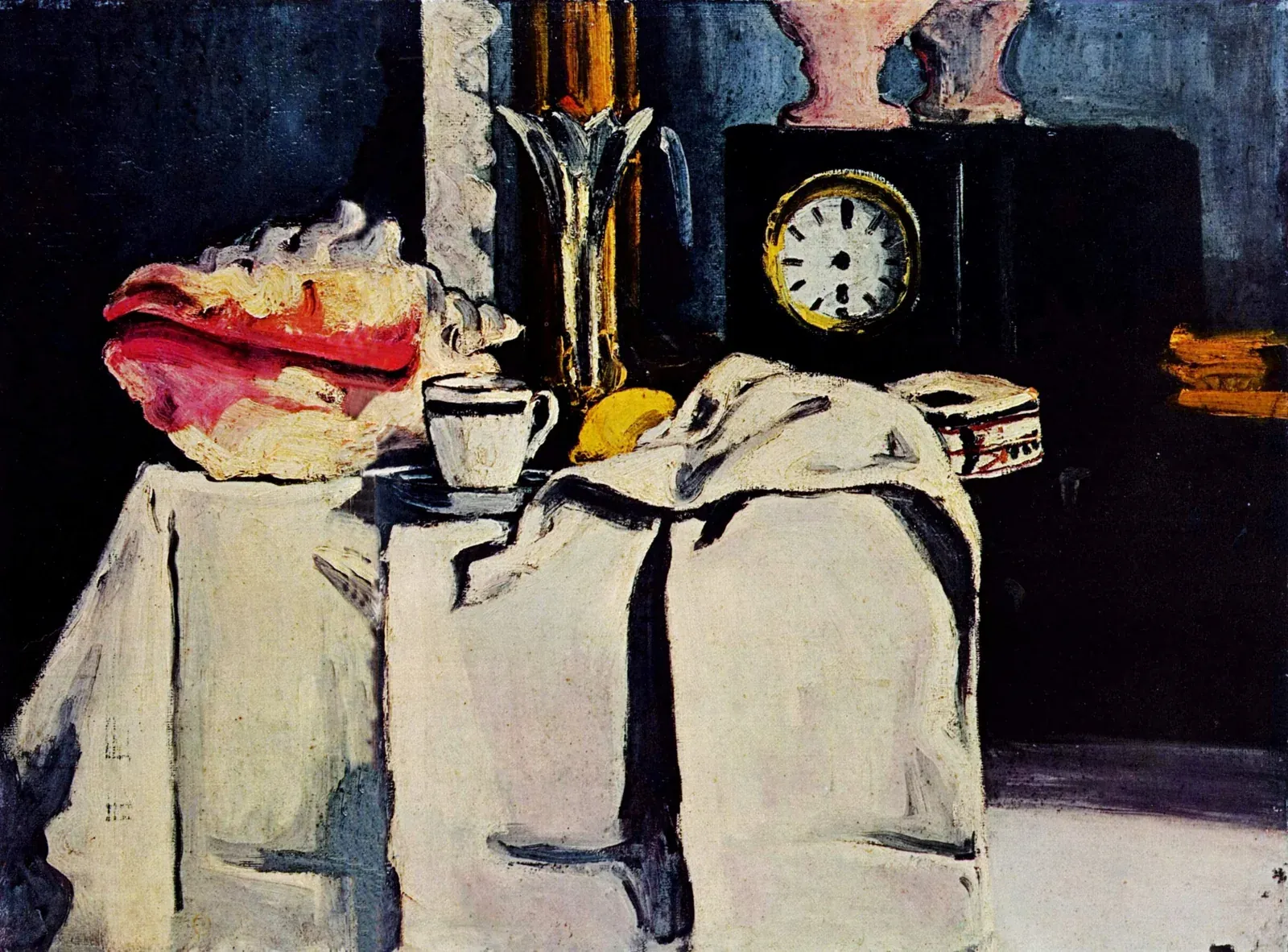
Image: Paul Cézanne, La Pendule noire / Wikimedia Commons, public domain.
Duas vezes por ano, os relógios mudam uma hora. Em março, adiantam-se; em outubro, recuam. Parece uma alteração pequena, mas pode mexer com o sono e com a forma como organizamos o dia.
Porque mudamos a hora?
O horário de verão foi adotado para distribuir a luz do dia de outra forma e reduzir o consumo de energia. Uma análise de estudos encontrou, em média, uma poupança de eletricidade pequena, que varia conforme o lugar e as condições estudadas.[1] Entretanto, tornou-se mais importante perguntar o que esta organização do tempo significa para o sono, a saúde e a vida quotidiana.
Há uma diferença essencial: mudar o relógio não encurta nem alonga o dia. A quantidade de luz natural muda ao longo das estações; o relógio altera a hora a que essa luz aparece nas nossas rotinas. Quando recua em outubro, o sol nasce e põe-se cerca de uma hora mais cedo no horário civil.
O que acontece ao nosso corpo
O nosso relógio biológico ajuda a regular o sono e a vigília e ajusta-se, em parte, pela luz que recebemos. A mudança da hora desloca de repente os horários sociais em relação à luz natural. Algumas pessoas notam sonolência, irritabilidade ou dificuldade em adormecer durante a adaptação; outras quase não sentem a diferença.
As duas mudanças também não são iguais. Em março, ao adiantar o relógio, perdemos uma hora na noite da transição e pode ser mais difícil acordar à hora habitual. Em outubro, ganhamos essa hora no relógio, mas isso não significa que todos durmam mais ou melhor. Num estudo com registos de sono de adultos no Reino Unido, o sono foi, em média, mais longo no domingo da mudança de outono; a investigação, no conjunto, encontra efeitos mais consistentes na transição de primavera.[2][3]
Para alguns indicadores de saúde, incluindo problemas cardíacos, há estudos que identificam um pequeno aumento de risco após a mudança de março. Para outros resultados, os dados são menos claros ou contraditórios. Não é adequado assumir que o mesmo risco existe nas duas transições, nem que uma noite diferente se traduz necessariamente num problema de saúde.[4]
O outono, a luz e o humor
Depois da mudança de outubro, quem passa o dia na escola ou no trabalho pode ter menos oportunidades de aproveitar a luz ao fim da tarde. O relógio não retirou uma hora de sol, mas alterou a forma como podemos usá-la.
Também não há uma resposta única sobre o efeito da mudança no humor. Um estudo dinamarquês encontrou mais contactos hospitalares por depressão nas semanas seguintes à transição de outono. Já um estudo inglês mais recente encontrou menos registos de depressão nos cuidados de saúde na primeira semana. Os estudos observam contextos e serviços diferentes; juntos, não permitem dizer que recuar o relógio provoca depressão em toda a população.[5][6]
Outra questão é a depressão com padrão sazonal, cujos episódios regressam em determinadas épocas do ano. A luz e os ritmos biológicos podem ter um papel importante, mas não se trata de uma consequência automática da mudança da hora. E sentir-se mais cansado ou menos motivado num dia escuro não equivale, por si só, a ter uma depressão. Em Portugal, um estudo com estudantes encontrou sensibilidade às estações, mas a amostra não permite estimar quantas pessoas no país têm depressão sazonal.[7][8]
Deve acabar a mudança da hora?
A Associação Portuguesa de Sono defende o fim das mudanças semestrais e, se houver um horário fixo, prefere a hora padrão, muitas vezes chamada «hora de inverno». O argumento principal é o maior alinhamento entre os horários sociais e a luz da manhã, importante para acertar o relógio biológico.[9]
Isso não torna a escolha simples para todas as pessoas. Manter o horário de verão durante o inverno daria mais luz ao fim da tarde no relógio, mas atrasaria o nascer do sol, deixando mais escuro o início do dia. Manter a hora padrão preservaria manhãs mais luminosas, à custa de tardes mais escuras. A decisão envolve saúde, escola, trabalho e hábitos de vida; os estudos disponíveis não atribuem um resultado uniforme a todas as regiões e pessoas.[4]
Como facilitar a adaptação
Enquanto as mudanças continuarem, algumas medidas podem tornar a transição mais confortável:
Proteja o tempo de sono: sobretudo antes da mudança de março, evite chegar à transição já com noites demasiado curtas. Se costuma sentir a alteração, ajuste gradualmente as horas de deitar e levantar nos dias anteriores.
Procure luz natural: se possível, saia de casa de manhã para dar ao corpo uma referência para o início do dia. No outono e no inverno, aproveite também a luz disponível noutras horas.
Mantenha alguma regularidade: horários de sono e refeições relativamente estáveis facilitam a adaptação.
Reduza a luz intensa antes de dormir: um ambiente mais calmo e escuro pode ajudar a preparar o sono.
Em resumo: a mudança do relógio pode perturbar o sono durante alguns dias; a diminuição da luz natural ao longo do outono é um processo diferente. Distinguir as duas coisas ajuda-nos a compreender melhor o que sentimos e a escolher o que fazer.
Se a tristeza, o cansaço ou as alterações do sono persistirem e interferirem com a vida quotidiana, vale a pena procurar apoio profissional. Não é preciso atribuir tudo à estação ou ao relógio para levar a sério o que se está a sentir.
Associação Portuguesa de Sono. (2021). A mudança da hora. Parecer apresentado em 2020 e ratificado em 2021.
Twice a year, the clocks change by one hour. They go forward in March and back in October. It may seem like a small adjustment, but it can affect sleep and the way we organise our day.
Why do we change the clocks?
Daylight saving time was introduced to redistribute daylight and reduce energy use. A review of studies found a small average saving in electricity, although results vary by place and circumstances.[1] The question of what this arrangement means for sleep, health and daily life has since become more important.
One distinction matters: changing the clocks does not make the day shorter or longer. The amount of natural light changes with the seasons; the clock changes when that light falls within our routines. When the clocks go back in October, sunrise and sunset occur about an hour earlier by civil time.
What happens in our body
Our biological clock helps regulate sleep and wakefulness and is guided partly by the light we receive. A clock change suddenly shifts social schedules in relation to natural light. Some people notice sleepiness, irritability or difficulty falling asleep while they adjust; others barely notice a difference.
The two changes are not the same. In March, moving the clocks forward removes an hour from the night of the transition and can make waking at the usual time harder. In October, we gain an hour on the clock, but that does not mean everyone sleeps longer or better. In a study using sleep records from adults in the UK, average sleep was longer on the Sunday of the autumn change; across the research, effects are more consistent for the spring transition.[2][3]
For some health outcomes, including heart problems, studies have identified a small increase in risk after the March change. For others, the evidence is less clear or conflicting. We should not assume that the same risk applies to both transitions, or that one unusual night necessarily causes a health problem.[4]
Autumn, light and mood
After the October change, people who spend the day at school or work may have fewer chances to enjoy daylight in the late afternoon. The clock has not taken away an hour of sunlight, but it has changed when we can use it.
There is no single answer about the effect of the clock change on mood. A Danish study found more hospital contacts for depression in the weeks after the autumn transition. A more recent English study, however, found fewer depression records in healthcare during the first week. The studies examine different settings and services; taken together, they do not show that putting the clocks back causes depression across the population.[5][6]
Depression with a seasonal pattern is a separate question: episodes return at particular times of year. Light and biological rhythms may play an important part, but this is not an automatic consequence of changing the clocks. Feeling tired or less motivated on a dark day is not, by itself, depression. A Portuguese study of students found seasonal sensitivity, but its sample cannot tell us how many people in Portugal experience seasonal depression.[7][8]
Should the clock change be abolished?
The Portuguese Sleep Association supports ending the twice-yearly changes and, if a fixed time is chosen, favours standard time, often called “winter time”. Its main argument is better alignment between social schedules and morning light, which helps set the biological clock.[9]
That does not make the choice simple for everyone. Keeping daylight saving time through winter would provide more evening light by the clock but delay sunrise, making the start of the day darker. Keeping standard time would preserve brighter mornings at the cost of darker evenings. Any decision involves health, school, work and daily habits; existing studies do not point to a uniform outcome for every region or person.[4]
How to ease the adjustment
While the changes continue, a few measures may make the transition more comfortable:
Protect your sleep time: especially before the March change, try not to approach it already short of sleep. If you usually feel the shift, move your bedtime and waking time gradually in the preceding days.
Seek natural light: if possible, go outside in the morning to give your body a cue that the day has begun. In autumn and winter, make use of daylight at other times too.
Keep a fairly regular routine: consistent sleep and meal times can make adjustment easier.
Reduce bright light before bed: a calmer, darker environment can help prepare you for sleep.
In summary: a clock change may disturb sleep for a few days; the gradual loss of natural light through autumn is a different process. Keeping the two apart helps us understand what we feel and decide what to do.
If sadness, tiredness or changes in sleep persist and interfere with daily life, it is worth seeking professional support. You do not have to blame everything on the season or the clock to take what you feel seriously.
Associação Portuguesa de Sono. (2021). A mudança da hora. Position statement presented in 2020 and ratified in 2021.
Deux fois par an, nous changeons l'heure. En mars, nous avançons les horloges ; en octobre, nous les reculons. Ce décalage semble minime, mais il peut modifier le sommeil et l'organisation de nos journées.
Pourquoi changeons-nous l'heure ?
L'heure d'été a été instaurée pour répartir autrement la lumière du jour et réduire la consommation d'énergie. Une analyse d'études a constaté une faible économie d'électricité en moyenne, variable selon les lieux et les conditions étudiées.[1] Depuis, la question de ses effets sur le sommeil, la santé et la vie quotidienne a pris plus d'importance.
Une distinction est essentielle : changer l'heure ne raccourcit ni n'allonge la journée. La durée de la lumière naturelle varie avec les saisons ; l'horloge modifie le moment où cette lumière s'inscrit dans nos habitudes. Quand elle recule en octobre, le soleil se lève et se couche environ une heure plus tôt à l'heure civile.
Ce qui se passe dans le corps
Notre horloge biologique contribue à régler le sommeil et l'éveil ; elle s'ajuste notamment grâce à la lumière reçue. Le changement d'heure déplace soudainement les horaires sociaux par rapport à la lumière naturelle. Certaines personnes ressentent une somnolence, une irritabilité ou des difficultés à s'endormir pendant l'adaptation ; d'autres ne remarquent presque rien.
Les deux transitions ne sont pas identiques. En mars, avancer l'horloge retire une heure à la nuit du changement et peut rendre le réveil à l'heure habituelle plus difficile. En octobre, nous gagnons une heure sur l'horloge, sans que cela signifie que tout le monde dort plus ou mieux. Une étude fondée sur des mesures du sommeil d'adultes au Royaume-Uni a observé un sommeil moyen plus long le dimanche du changement d'automne ; dans l'ensemble, la recherche trouve des effets plus constants pour la transition du printemps.[2][3]
Pour certains indicateurs de santé, notamment les problèmes cardiaques, des études ont relevé une légère hausse du risque après la transition de mars. Pour d'autres, les résultats sont moins clairs ou contradictoires. Il serait trompeur de supposer que le même risque existe aux deux transitions, ou qu'une nuit différente entraîne nécessairement un problème de santé.[4]
L'automne, la lumière et l'humeur
Après le changement d'octobre, les personnes qui passent la journée à l'école ou au travail peuvent avoir moins d'occasions de profiter de la lumière en fin d'après-midi. L'horloge n'a pas retiré une heure de soleil, mais elle a changé le moment où nous pouvons en profiter.
Il n'y a pas non plus de réponse unique sur l'effet du changement d'heure sur l'humeur. Une étude danoise a trouvé davantage de contacts hospitaliers pour dépression dans les semaines suivant la transition d'automne. Une étude anglaise plus récente a toutefois relevé moins de cas de dépression enregistrés dans les services de santé durant la première semaine. Les deux études portent sur des contextes et des soins différents ; ensemble, elles ne permettent pas d'affirmer que reculer l'horloge provoque une dépression dans l'ensemble de la population.[5][6]
La dépression à caractère saisonnier est une autre question : ses épisodes reviennent à certaines périodes de l'année. La lumière et les rythmes biologiques peuvent jouer un rôle important, mais ce n'est pas une conséquence automatique du changement d'heure. Se sentir fatigué ou moins motivé pendant une journée sombre ne signifie pas, en soi, être dépressif. Au Portugal, une étude menée auprès d'étudiants a trouvé une sensibilité aux saisons, mais son échantillon ne permet pas d'estimer combien de personnes dans le pays connaissent une dépression saisonnière.[7][8]
Faut-il supprimer le changement d'heure ?
L'Association portugaise du sommeil défend la fin des changements semestriels et, si une heure fixe est retenue, préfère l'heure normale, souvent appelée « heure d'hiver ». Son principal argument est un meilleur alignement entre les horaires sociaux et la lumière du matin, qui aide à régler l'horloge biologique.[9]
Le choix n'est pourtant pas simple pour tout le monde. Garder l'heure d'été en hiver donnerait davantage de lumière en fin de journée à l'horloge, mais retarderait le lever du soleil et assombrirait les matinées. Garder l'heure normale préserverait des matinées plus lumineuses, au prix de soirées plus sombres. La décision touche à la santé, à l'école, au travail et aux habitudes de vie ; les études ne prédisent pas un résultat uniforme pour toutes les régions et toutes les personnes.[4]
Comment faciliter l'adaptation
Tant que les changements continueront, quelques mesures peuvent rendre la transition plus confortable :
Préservez votre temps de sommeil : surtout avant le changement de mars, essayez de ne pas arriver à la transition avec un manque de sommeil. Si vous y êtes sensible, décalez progressivement vos heures de coucher et de lever dans les jours précédents.
Profitez de la lumière naturelle : si possible, sortez le matin pour donner au corps un repère pour le début de la journée. En automne et en hiver, profitez aussi de la lumière à d'autres moments.
Gardez une certaine régularité : des horaires de sommeil et de repas relativement stables peuvent faciliter l'adaptation.
Réduisez la lumière vive avant de dormir : une ambiance plus calme et sombre peut aider à préparer le sommeil.
En résumé : le changement d'heure peut perturber le sommeil pendant quelques jours ; la diminution progressive de la lumière naturelle en automne est un autre phénomène. Les distinguer aide à mieux comprendre ce que l'on ressent et à choisir comment y répondre.
Si la tristesse, la fatigue ou les troubles du sommeil persistent et gênent la vie quotidienne, il vaut la peine de demander un soutien professionnel. Il n'est pas nécessaire de tout attribuer à la saison ou à l'horloge pour prendre au sérieux ce que l'on ressent.